The work, one question at a time
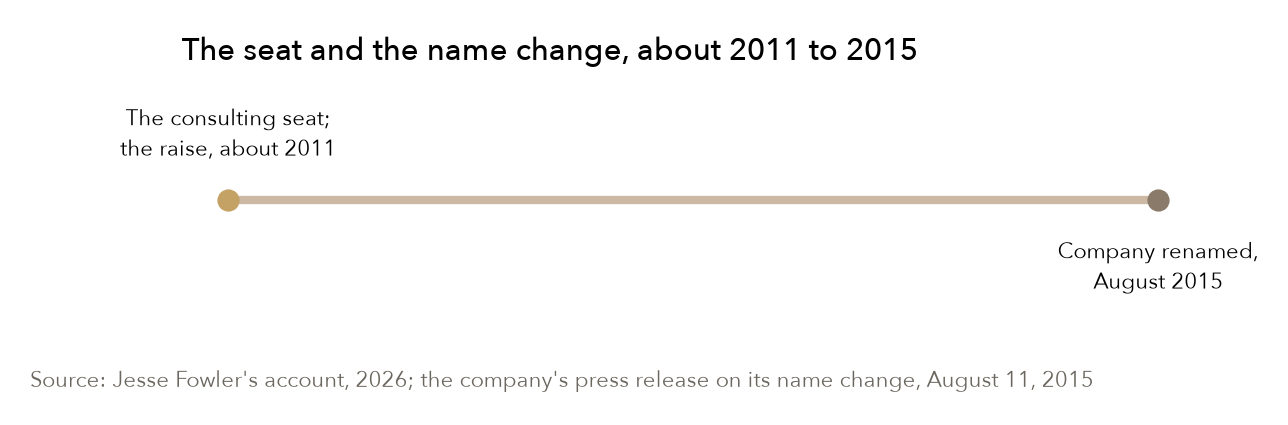
- Take the seat. Known: a filing shows the commercial story and nothing about the company's own engineering confidence. Not known: whether the claim held, and whether anyone outside the company had put money behind it. The question was whether a seat would get me a different kind of information than a reader of the filings had. It produced the consulting role and the equity that came with it, and it moved my read of the company from its disclosures to its people.
- Get the claim stated as a mechanism, not a payoff. Known: the release described what the technology was supposed to achieve. The question I asked inside was what it actually did to the oil, the pipe or the flow, plainly, in words a stranger could test, because the physics has to come before the pitch. Anything that moves oil through a pipe more cheaply has to change something physical, and operators already pay for standing ways to do that, so the second half of the question was which of those this had been compared against. Asking it is the whole point of being in the room; the answer, wherever it lands, is what a filing cannot give you.
- Find out who else was paid to say it worked, and whether any operator had put money or a test bay behind it. Known: the names on the company's own materials. The question was whether an outside lab had been paid to test the claim, and whether a pipeline company had signed anything with a schedule on it. That is the checkable proxy for a technical claim when you cannot run the physics yourself, and it is the question I would put to any small company with a big claim today.
- Help raise the money, and keep it separate from the finding. Known: the company needed capital to keep working, and the need had a clock. I helped raise it; the figure on the cover is the one number in this engagement a reader could check. What I refused to do was let the raise stand in for the answer to questions 2 and 3. Capital raised measures persuasion, and the company was persuasive. It does not measure physics, and a report that uses one to prove the other has done no diligence at all.
- Read the name change for what it was. Known: in August 2015 the company renamed itself QS Energy. A new name is not a milestone, and I did not treat it as one; the question was what had changed underneath it, in the engineering or the customer list. A company's announcements tell you what it wants believed on that date. The claim is tested by the first three questions and nothing else, keeping what happened separate from what you believed.
A filing is written to persuade you. I wanted to stand next to the people making the claim and ask what a pipeline operator would ask. Close range counts as diligence when it produces a page someone who was not there could check. That is the rule I keep, and this seat is where it started.
What it produced
Access, first. The seat got me into the room with the people making the claim, which is the one thing a reader of the filings never has, and the questions above were asked there, of the people who could answer them, rather than of a document written to persuade. The raise on the cover gave the company the runway it was asking for.
The durable product is the method. Five questions, in the order I would ask them now, with what a filing gives you against each one and what a seat inside the company gives you. They are the questions I would put to any hard technical claim today, in energy or outside it, and they are drawn below so a reader can follow them row by row.
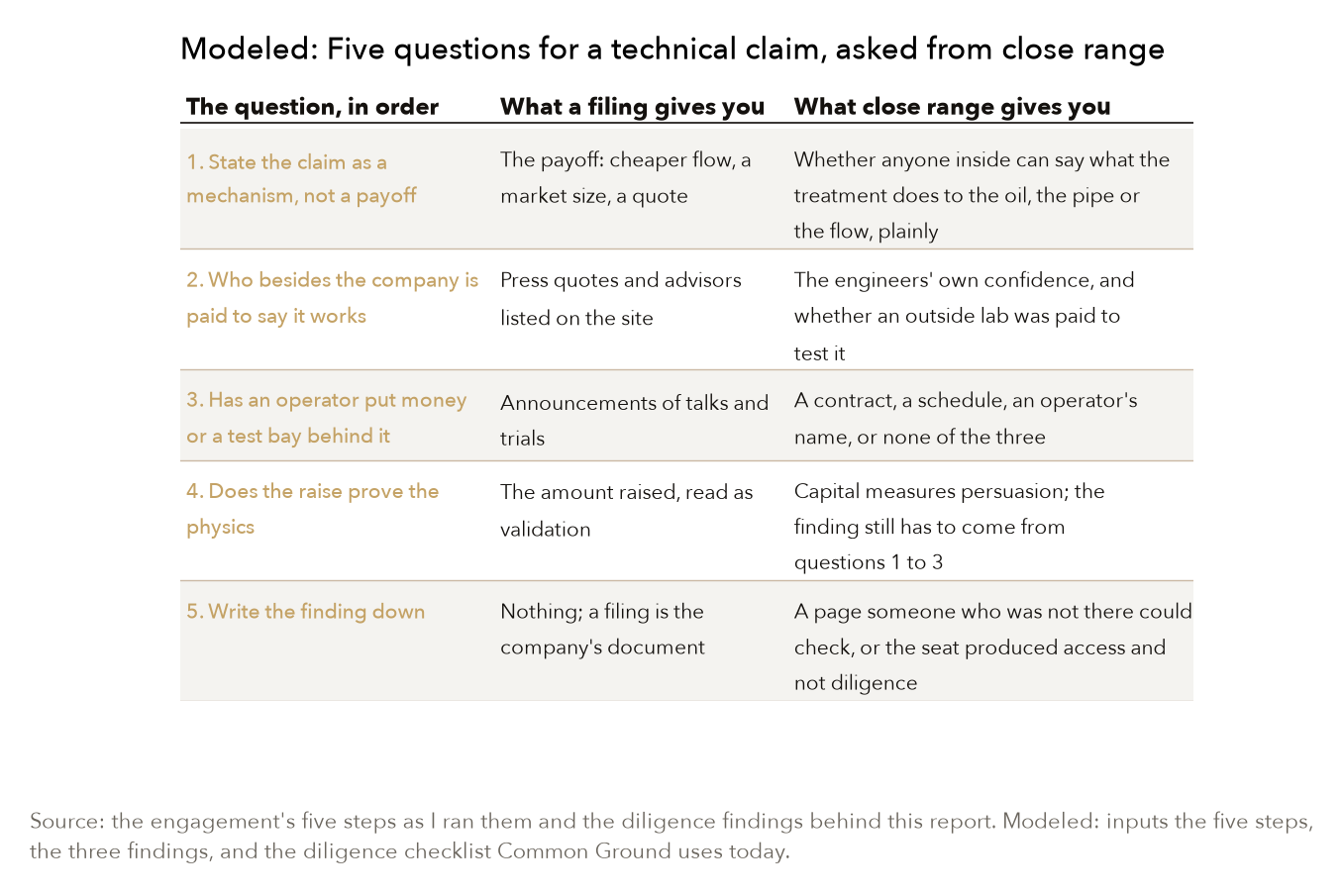
Two of those rows are worth saying in prose. A raise proves the company can persuade; it does not prove the technology, and the two are easy to confuse when you helped with the raise. And a name change or an announcement are events in the company's story, not findings about the claim. The finding is the answer to the first three questions, written down where someone else can check it.
What we kept, replaced and installed
We kept the company's story, read as what it was: a sales document, useful for knowing what the company wanted a buyer to believe and useless as evidence that the buyer should. I did not try to change how the company told its story. That was not my seat.
What I replaced was a habit, and it is the habit every reader of a public company has, because a filing is the only document on offer: reading the persuasive version and calling it diligence. The fault in that logic is that it assumes the persuasive version is the only version, when a seat inside the company reaches a second one. It had to change in 2011 rather than later because the raise had a clock on it, and the time to know whether the claim held was before the money went in, not after.
What I installed is the rule the seat taught me.
The written-finding rule
Any time getting close is the reason I take a seat or an engagement, the closeness has to produce a page: what the claim is as a mechanism, who besides the company is paid to say it works, whether an operator has put money or a test bay behind it, and what I saw inside that a filing did not show. Close range counts as diligence when that page exists and someone who was not there could check it.
What it cost to hold the line, and what I would watch
It cost independence. A consultant with equity in the company he is testing has a reason to want the claim to be true, and I felt it. The cure is the written page, and it is why the rule is written the way it is.
It cost time in a room outside my trade. Years of standing in front of other people's work teaches you when a wall is plumb, and I brought that instinct to a company whose work did not show itself that way. Physical closeness to a team is not physical closeness to their physics. That is the over-application I watch for now: a builder's confidence in what he can see, applied to something he cannot.
What I would watch, on any small company with a big technical claim:
- The claim as a mechanism. If nobody inside can say plainly what it does to the oil, the pipe or the flow, the claim is a payoff with a story attached.
- Who else is paid to say it works. A payroll engineer, a broker and a release all have the same incentive. Find the outside lab or the operator with a test bay, or note that there is none.
- The raise is not the finding. Capital raised measures persuasion. Keep it on a different page from the physics, especially when you helped raise it.
- Announcements are not findings. A rename and a release tell you what the company wants believed that day. They tell you nothing about whether the technology works.
- Write it down. Close range counts when it produces a page someone who was not there could check.
The result, in short
About $3M raised for the company with my help, and the method that came out of the seat: five questions, asked from inside, that I would put to any hard technical claim today. Access, first: the seat got me into the room with the people making the claim, which a reader of the filings never has. The durable product is the method, drawn out as five questions, in the order I would ask them now, against any hard technical claim, in energy or outside it.
A slice of the project list
A few related projects.
- Aycre Capital: fund formation and capital raise process (2022 to 2023)
- BridgePoint Air: exit advisory and sale negotiation (2024 to 2025)
- Sublime Medical: fractional COO, cosmetic dermatology group (2015)
- Canyon Corporate: takeoff, pricing structure and bid revision for an office-to-residential conversion (2026)